Learning how to lead
April 26, 2026
This started as curiosity. The same instinct that pulled me into building things — first with my hands, later with code — eventually asked a harder question: what does it take to lead them? Not as a title. As a practice.
I came to it the way I came to construction. Slowly. By trying. By getting it wrong on someone else's home and having to make it right. What I have learned, more than anything else, is that courage is not the absence of fear. It is being scared and doing the thing anyway.
What follows is not a theory. It is what six years of working in the physical world taught me about leading people, before I ever shipped a line of code from a studio of my own.
Leadership has a domain
Everyone leads. The harder part is finding the room where it is true for you.
Some people command a kitchen on a Friday night like a general and cannot ask the waiter for more napkins on a Tuesday. Some people hold a hospital ward together at three in the morning and go silent at a dinner party. Some people run a code review with quiet authority and disappear at family gatherings. None of them is a worse leader in the second room. They are just out of the one where leadership is theirs.
That is the part I think most people miss. Leadership is not a personality. It is the room where your nervous system already knows the moves — where the question "what do we do now" finds its answer in you before anyone else has spoken. Outside that room, you are a regular person, and that is fine.
The only way to find your room is to pay attention. To yourself. Across enough situations that a pattern emerges.
Watch what makes you nervous. Watch what puts you at ease. Watch where your hands stop shaking and your voice finds its register. Watch which distractions you reach for when a room overwhelms you, and notice which of those distractions are healthy enough that you can return to the work afterwards — the fallbacks that keep you in the work, not the ones that take you out of it.
You learn your own leadership by catching it happening, in dozens of small situations, until the shape is clear. It cannot be decided in advance. It can only be noticed.
What construction taught me about leadership
I did not learn leadership in a software studio. I learned it on construction sites, six years of it, before I ever ran a company anyone could install on their phone.
A few things you do not really understand until you have done them with your hands.
You cannot fake a level
A wall is plumb or it is not. A floor is square or it is not. Drywall does not care how confident you sound. The building tells you the truth every time, in a way no spreadsheet ever will. Leading people whose work meets that kind of reality teaches you fast that words have to match the work, or the work will say so plainly.
The stud you cannot see is what holds the wall
What makes a finished room beautiful was decided weeks earlier, behind the drywall, by someone patient enough to do the framing right. Leadership is the same. The visible moment — the hard conversation, the launch, the decision people remember — is held up by a thousand small invisible choices made months before, when nobody was watching.
Measure twice, cut once is not a slogan, it is a rule
The cost of being wrong on a finish piece is a day, sometimes two. Most of leadership, in any field, is just refusing to act before you have measured. The rush to decide is almost always the trap. Patience compounds.
You cannot lead a job you have not done
This is the only part I feel strongly about. I think it is the entire job.
If I have not laid brick on a wall, I cannot lead the mason I might one day hire. I will not know how long a course of brick takes when the temperature drops. I will not know what makes a joint look right or wrong. I will not know the small dignity of a clean line, or the particular exhaustion of pointing for hours.
If I have not stood in someone's living room and explained why their kitchen is going to be unusable for three weeks, I cannot lead a project manager through that conversation. The script does not exist on paper. It exists in the body — in the small tightening of someone's voice when you tell them the truth, in your willingness to sit with their disappointment and finish the conversation anyway.
So I do every job first. Not as a virtue. As a precondition.
This held across the construction years, and it holds now in the studio. The principle does not change between rooms. Learning the process is the only honest way to lead anyone through it. If you have not done a job, you do not know what good looks like in it. And if you do not know what good looks like, you cannot lead someone toward it. You can only push them.
On the courage part
The piece I keep coming back to is the courage part. Curiosity gets you to the door. Courage is what gets you through it.
Most of what I have done over the last decade scared me. The first wall I had to tear out because I had measured wrong. The first inspector who failed a rough-in I was sure was right. The first time I had to tell a homeowner the work was going to take longer than I had quoted, and watch their face. The first time a sub walked off and I had to finish his work myself before the next morning. Hiring someone — taking on the responsibility of another person's livelihood — for the first time, in either career.
None of it came naturally. All of it was learned by doing the thing while scared, and noticing afterwards that I was still standing, and the work still got finished.
I used to think courage was something you either had or did not. I do not think that anymore. Courage is a daily practice of not letting fear pick the smaller version of the next move.
The studio brought new fears, but the practice was the same. By the time I was facing them, I had already spent years learning that fear is not a signal to stop. It is just the room where leadership lives.
The cover idea
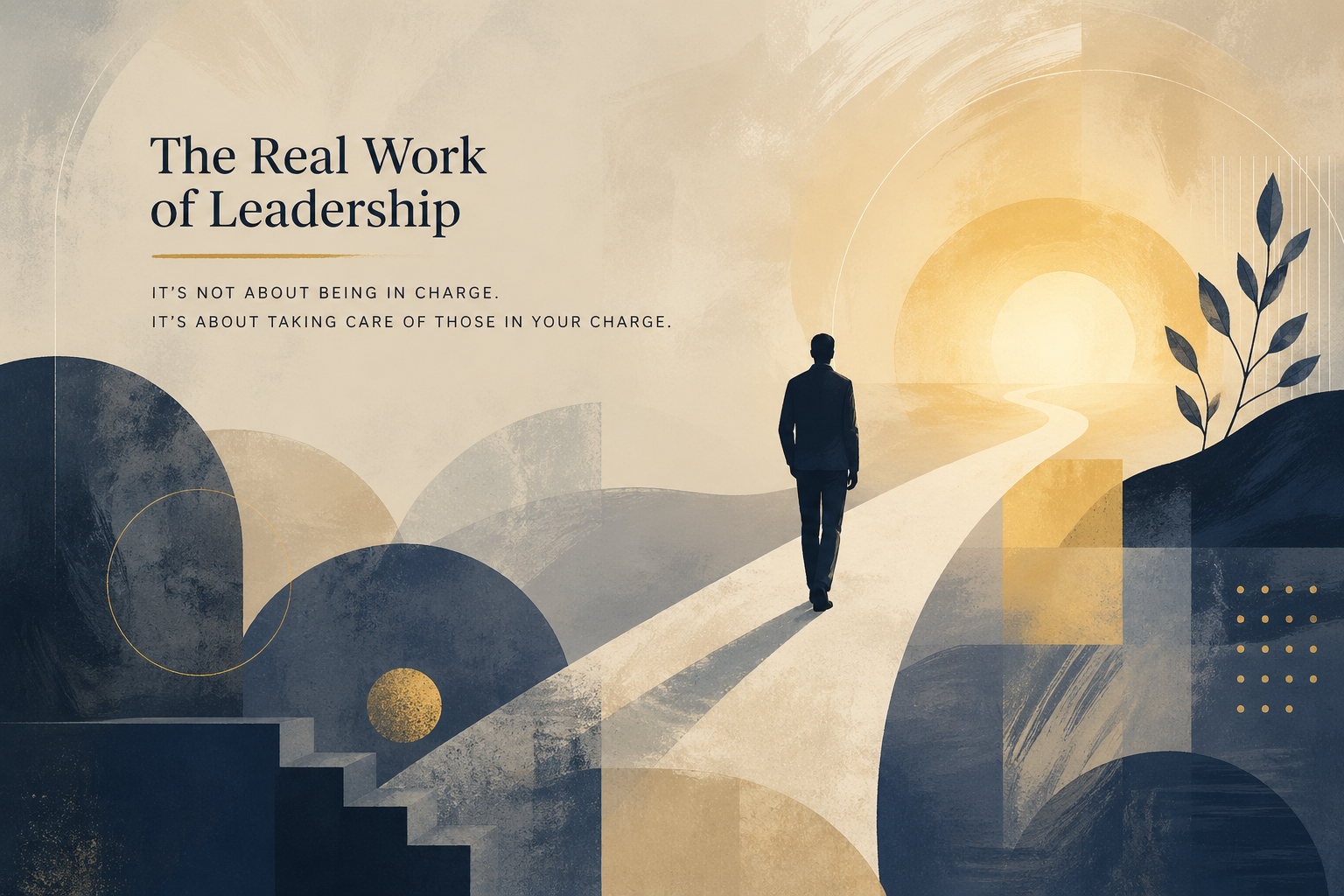
It is not about being in charge. It is about taking care of those in your charge.
What the work asks of you, eventually, is a willingness to be uncomfortable on behalf of other people. To make the call you do not want to make. To answer the question you do not have a clean answer to. To go first into the work you will one day ask someone else to do.
That is the only kind of leader I want to learn how to be. The kind who walks the shoes first, and shows up scared, and goes anyway. The kind whose work holds up after they have left the site.
Everything else is a costume.